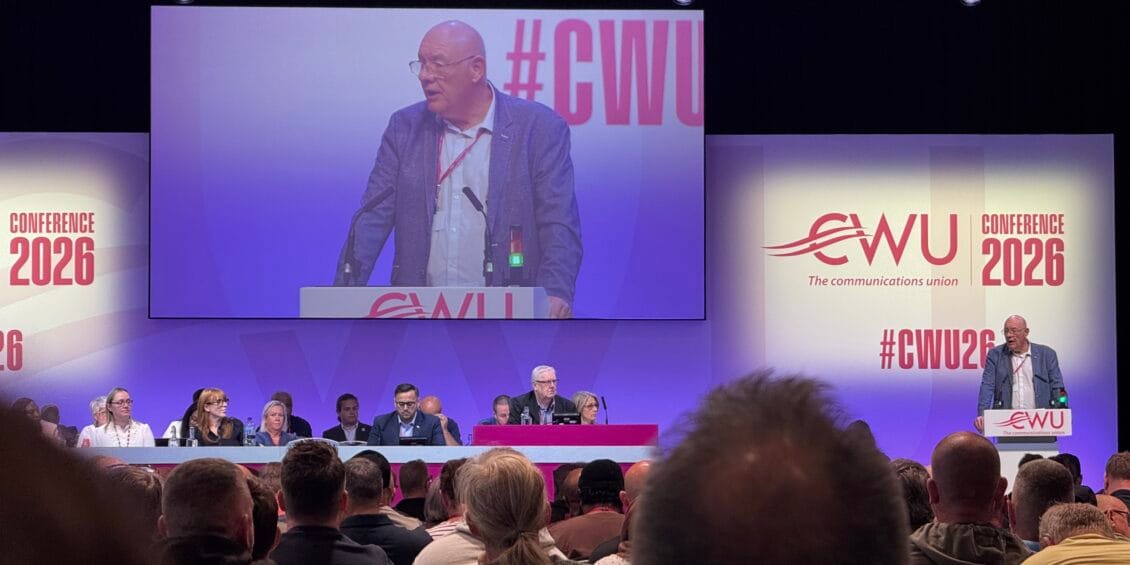

Amid all the political drama over the weekend, with the fallout from the elections and then calls on the Prime Minister to resign, there was also a significant development in the campaign for proportional representation.
On Sunday, members of the Communication Workers Union (CWU) voted decisively to reject Westminster’s failing First Past the Post (FPTP) electoral system and back a move to proportional representation, marking a historic shift for the Labour-affiliated union.
For me, this was another significant step forward in the campaign for proportional representation. Not only is CWU a large union in its own right, but it is also one of the influential ‘big five’ unions affiliated to the Labour Party. That means it has an official link to Labour and a role in its policy-making processes.
CWU’s vote comes after Unite, Unison and Usdaw have all voted to back electoral reform in recent years. Sunday’s vote shows how support for ditching First Past the Post has become the overwhelming position in the Labour-affiliated trade union movement.
Delegates overwhelmingly passed a motion at the union’s annual conference in Bournemouth warning that “FPTP is producing unrepresentative results and is at crisis point,” also describing it as “unsustainable and dangerous”.
The union cited the government’s move to scrap FPTP for mayoral elections and urged that “there has never been a clearer need to change the First Past the Post (FPTP) voting system in Westminster too.”
FPTP is ‘unstable, dangerous and at crisis point’
Trade unionists have always been at the forefront of the fight for fairness and democracy, which is why CWU delegates voted decisively to reject the failing First Past the Post system and back electoral reform.
The motion called on the union to “reject First Past the Post and support the introduction of a form of Proportional Representation that maintains the constituency link and in which all votes count equally and seats match votes.”
It also called for the government to hold an “independent Commission for Electoral Reform”.
There was an animated debate in the conference hall, which ended with the Union’s executive committee outlining its support for ditching FPTP in favour of PR, and then a large majority of delegates voting in favour.
I was down in Bournemouth with Politics for the Many and the Electoral Reform Society, running a stall and talking to delegates about the case for PR.
Following the vote, Ed Baldwin a delegate from the CWU Kent Invicta Branch and a political officer for the south east region who proposed the motion, said:
“First Past the Post no longer reflects those we represent and is producing results that do not match the will of the people.
“The Labour government has already accepted it is broken by scrapping it for mayoral elections. If it distorts democracy there, then it distorts democracy at Westminster too.
“This motion is a demand for fairness, representation and a democracy that works, and CWU has never been afraid to challenge systems that fail working people. It is time for our union to lead and help make proportional representation a reality.”
CWU vote represents a sea change in Labour-affiliated unions on PR
The move highlights the huge shift in the trade union and Labour movement in recent years as CWU becomes the eighth of the 11 Labour-affiliated unions to make electoral reform its official policy. Of the remaining unions, two (Community and NUM) do not have a policy on electoral reform and GMB, also considered one of the big five, is currently opposed.
The impact of growing trade union support for electoral reform has already been seen in the Labour Party as the affiliate unions were key to the passing of the 2022 conference motion supporting the move to proportional representation.
It is clear to me that we cannot continue with a voting system that ignores millions of votes and is producing more and more chaotic results that do not represent the way people have voted.
I believe this marks a sea change in the Labour movement. The party’s politicians at Westminster now need to listen to these collective voices and act to make electoral reform a reality.